MITSUBISHI ELECTRIC Changes for the Better

Residual current circuit breakers are a key component of modern low-voltage installations. They detect residual currents to earth and automatically switch off the affected circuit before dangerous contact voltages or consequential damage can occur.

Mitsubishi Electric offers a wide range of residual current devices (RCDs) that are specially designed for use in residential buildings, commercial properties and industrial applications.

What is an RCD / residual current device?

An RCD is a protective device that continuously monitors the incoming and outgoing current in an electrical circuit. If the incoming and outgoing currents differ, there is a fault current – for example, due to insulation faults, damaged cables or a person coming into contact with live parts. If a defined differential current is exceeded, the residual current device trips and completely disconnects the circuit from the mains within a short time.

While circuit breakers protect against overload and short circuits, the RCD specifically addresses the risk of electric shock. This makes it an indispensable protective measure, especially in areas with a high risk to people – such as bathrooms, outdoor areas or in amateur installations – while also helping to reduce the risk of fire caused by fault currents.

How does an RCD work technically?

Inside a residual current circuit breaker there is a summing current transformer through which all active conductors of a circuit are routed. If the same current flows through the outer conductor and neutral conductor during normal operation, the magnetic summing effect in the transformer is zero. If a residual current occurs, for example to earth, a difference arises – the total current is not zero, and a voltage is induced in the transformer.

This voltage controls a tripping mechanism that opens the switch within a specified time. For RCDs designed for personal protection, the rated differential current is usually 30 mA in order to significantly reduce the risk of life-threatening body currents. For fire protection or system protection tasks, sensitivities of 100 mA or 300 mA are often used.

Normative requirements and areas of application for RCDs

The DIN VDE 0100-410 standard defines essential requirements for protection against electric shock and stipulates the use of residual current devices in many areas, including socket circuits up to 32 A, certain outdoor circuits and lighting circuits in homes.

Typical areas of application for RCDs are:

  • Residential buildings, especially bathrooms, kitchens and outdoor areas
  • Kindergartens, schools, care facilities and accommodation establishments
  • Commercial and industrial facilities with high personal safety requirements
  • Installations with increased fire risk or with valuable property

Residual current circuit breakers are therefore a key tool for implementing normative requirements in practice and sustainably increasing the safety level of electrical systems.

    Overview of residual current devices (RCDs) from Mitsubishi Electric

    Mitsubishi Electric offers a comprehensive range of RCD residual current circuit breakers as modular DIN rail components. The standard range includes sensitive type A devices with a rated residual current of 30 mA, available in 2-pole and 4-pole versions and rated currents from 25 A to 125 A. These are ideal for protecting against earth faults in final circuits.

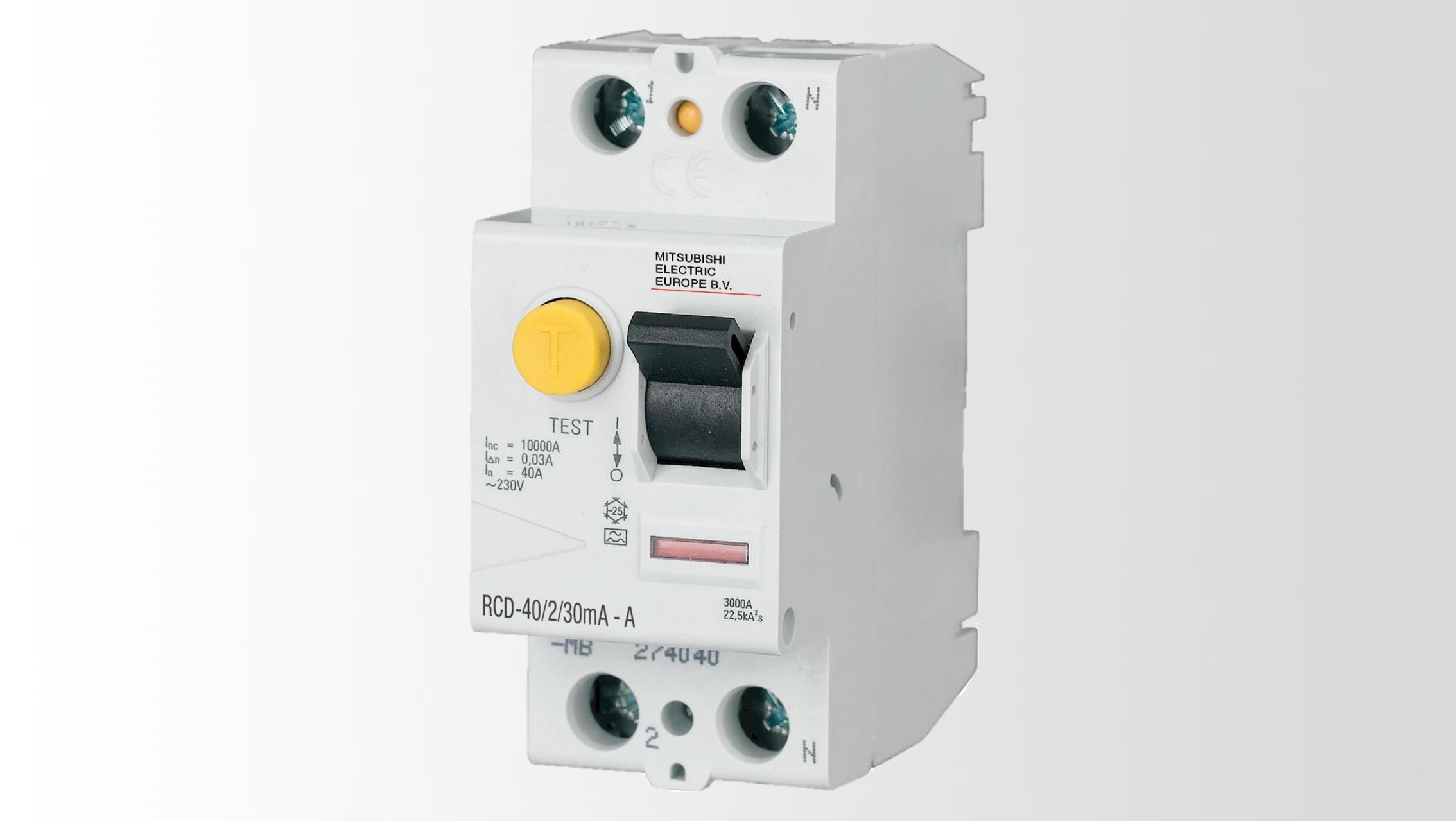
    On the overview page for Mitsubishi Electric RCD residual current circuit breakers, electrical contractors will find a structured presentation of the available series, types and rated current ranges. For specific applications, device details such as the RCD-40/2/30mA - A (2-pole, 40 A, 30 mA) or the RCD-100/4/30mA - A (4-pole, 100 A, 30 mA) are available – each with technical data, dimensional drawings and a download area. In addition to type A devices, type B residual current circuit breakers are also available for applications with direct current components, such as certain frequency converter or charging infrastructure applications. This allows protection concepts to be specifically adapted to modern consumer landscapes.

    Typical applications for RCDs in practice

    In practice, RCDs are used wherever people, livestock or property need to be reliably protected against fault currents. In residential buildings, they protect socket and lighting circuits, while in functional buildings they often also protect specific areas with increased risk, such as kitchens, laboratories or sanitary areas.

    In industrial or commercial facilities, residual current circuit breakers are particularly relevant where:

    • many sockets installed by laypersons,
    • damp or conductive environments are present,
    • portable electrical equipment is in use, or
    • special requirements for fire protection and availability exist.

    By combining RCDs with different tripping currents and selectivity concepts, graduated protection strategies can be implemented that take into account both personal and equipment protection.

    Selecting the appropriate RCD

    The selection of the appropriate residual current circuit breaker depends on several factors:

    • Nominal current and number of poles of the circuit to be protected
    • Fault current sensitivity (e.g. 30 mA for personal protection, 100/300 mA for fire or system protection)
    • Fault current type (type AC, A or B) depending on connected consumers
    • Ambient conditions and requirements of the respective standards and technical connection conditions

    Mitsubishi Electric's RCD portfolio covers a wide range – from compact 2-pole RCDs for typical residential circuits to more powerful 4-pole devices for three-phase applications. On the RCD residual current circuit breakers page, installers can filter by rated current, number of poles, sensitivity and size to select the right device.

    Our standard range of Residual Current Circuit Breakers RCD are type A sensitivity devices with 30mA setting. These are available from 25A to 125A in 2pole and 4pole versions. They are ideal for protecting against earth leakage faults. We also have available type B sensitivity devices for DC loads. We can also supply in 100mA and 300mA versions. Our RCD devices are certified to EN61008-1.

    RCD in a system network with other protective devices

    In low-voltage distribution systems, RCDs do not operate in isolation, but in conjunction with circuit breakers, RCBOs, AFDD switches and surge protection devices. With its modular MDRC series, Mitsubishi Electric offers a comprehensive system of DIN rail components that combines personal protection, system protection and fire protection in a consistent product portfolio.

    For example, RCDs can be used as central residual current devices in sub-distribution boards, while RCBOs provide combined overcurrent and residual current protection for individual circuits and AFDD switches enable additional arc fault detection. This gives planners and installers maximum flexibility to implement protection concepts in accordance with standards and optimised for the application.

    FAQs about RCDs

    What exactly does an RCD do?

    An RCD monitors the flow of current in the circuit and compares the incoming and outgoing currents with each other. If a fault current occurs, for example via a person or due to a damaged cable to earth, the RCD detects the difference and automatically switches off the circuit. This significantly reduces the risk of electric shock and also contributes to fire safety.

    When is the use of an RCD switch mandatory?

    The DIN VDE 0100-410 standard requires residual current devices for, among other things, socket circuits up to 32 A that are intended for general use by laypersons, for certain outdoor circuits and for lighting circuits in homes. In addition, many technical regulations recommend the use of RCDs wherever there is an increased risk of personal injury or fire.

    What sensitivity should an RCD have?

    Residual current circuit breakers with a rated residual current of 30 mA are used for personal protection. They limit the possible body current in such a way that serious damage to health becomes significantly less likely. For fire or system protection tasks, 100 or 300 mA RCDs are often used, for example as a higher-level protective device in distribution systems. The specific sensitivity required is determined by standards, network type and application.

    Was ist der Unterschied zwischen FI-Schalter (RCD) und FI/LS (RCBO)?

    A classic residual current device (RCD) only provides fault current protection and is usually used in conjunction with an upstream circuit breaker. An RCD/LCB switch – technically known as an RCBO (residual current circuit breaker with overcurrent protection) – combines residual current protection and overcurrent protection in a single device. In addition to pure RCD residual current circuit breakers, Mitsubishi Electric also offers RCBO devices as modular top-hat rail components, which are particularly suitable for selective protection concepts on individual final circuits.

    We are pleased to advise you personally!

    The fields marked by a * are mandatory.