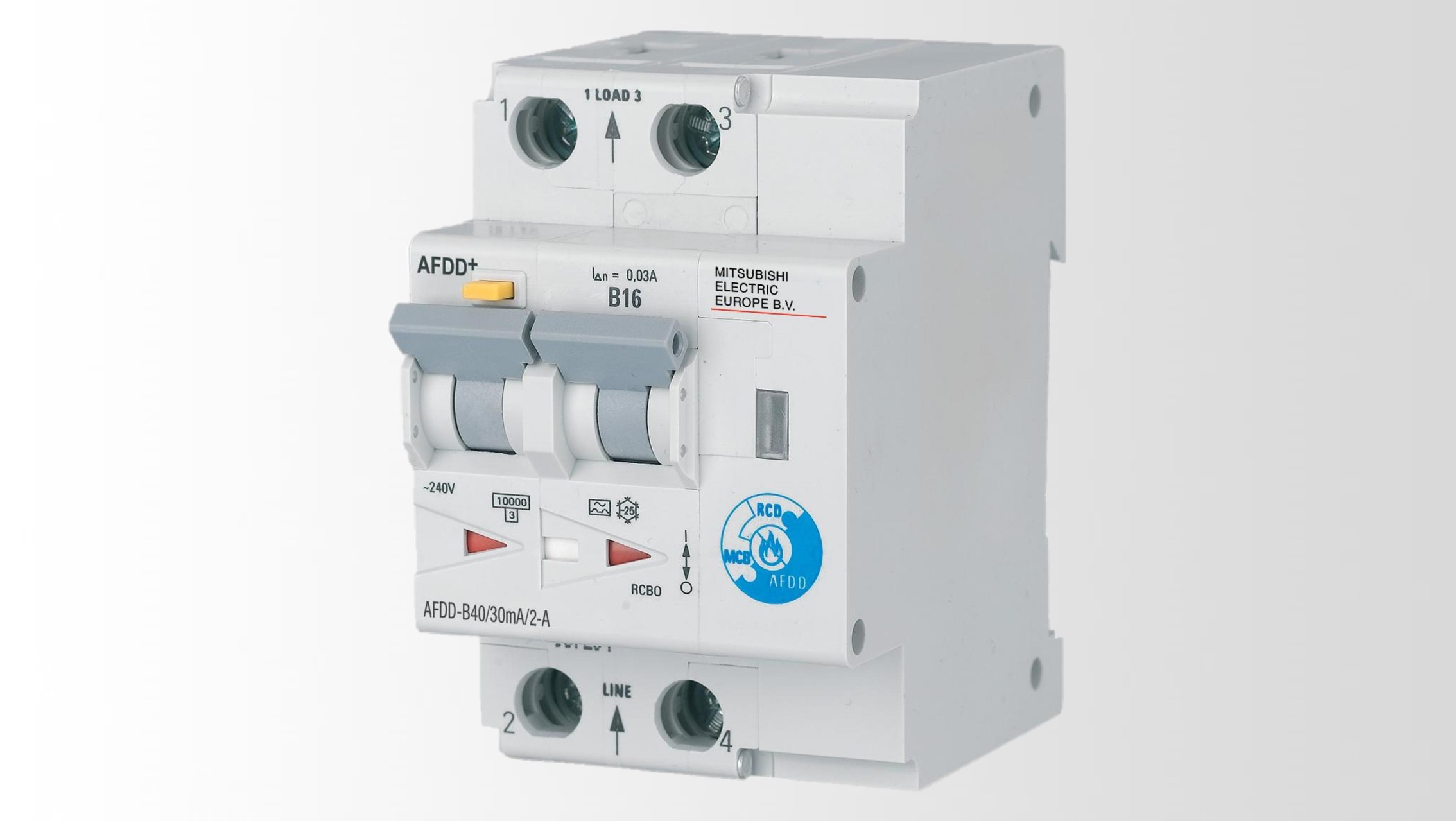
Electrical systems in residential buildings, industry and public facilities must meet the highest safety standards today. Classic protective devices such as circuit breakers (LS) and residual current devices (FI/RCD) are indispensable, but they reach their limits when it comes to one specific hazard: fault arcs. AFDDs (Arc Fault Detection Devices) from Mitsubishi Electric close this safety gap.
They detect dangerous serial and parallel arcs before they can start a fire and, in combination with integrated circuit breakers and residual current devices, offer maximum safety in the smallest of spaces.
What is an AFDD and how does it work?
An AFDD (often colloquially referred to as a fire protection switch) is an intelligent protection device for final circuits. While conventional fuses only react to "too much current" (overload/short circuit) or "current in the wrong place" (fault current), the AFDD virtually "listens" to the line.
Using digital signal processing and integrated microprocessors, it continuously analyses the current and voltage waveforms for typical high-frequency patterns. It reliably distinguishes between:
- Operating arcs: Non-hazardous sparks that occur, for example, in the brush fire of a drill.
- Fault arcs: Hazardous discharges caused by broken cables, loose terminals or crushed cables, which can generate temperatures of several thousand degrees.
If the algorithm detects a critical signature, the device disconnects the affected circuit from the mains in a fraction of a second.
Closing the protection gap: RCD vs. FI vs. AFDD
Many users ask themselves: "Do I need an AFDD if I already have an RCD?" The answer is a clear yes, because the devices cover different hazard areas:
Serial arcing faults in particular (e.g. a broken cable in the wall or a loose connection in a socket) are not detected by either the circuit breaker or the residual current device, as no current flows to earth and the current flow often remains below the trip threshold of the circuit breaker. This is precisely where the AFDD prevents smouldering fires.
Areas of application and standards: When is a fire protection switch mandatory?
The DIN VDE 0100-420 standard plays a central role in planning. It requires the use of fault arc protection devices in certain areas or strongly recommends a risk analysis.
Typical areas of application according to the standard and recommendation:
- Bedrooms and common rooms: In daycare centres, retirement homes, barrier-free apartments and hotels.
- Buildings with increased fire risk: Places where flammable materials are processed or stored (e.g. carpentry workshops, barns).
- Combustible building materials: Wooden houses or buildings with timber frame construction.
- Irreplaceable goods: Museums, galleries, archives and listed buildings.
Planners and electricians use Mitsubishi Electric AFDDs to implement regulatory requirements in a legally compliant manner and minimise liability risk in the event of damage.
AFDD solutions from Mitsubishi Electric: 3-in-1 protection
Mitsubishi Electric relies on combination devices that reduce the installer's workload and save space in the distribution board. Our AFDD arc fault circuit breakers typically combine three functions in a single housing:
- Arc fault detection (AFDD unit)
- Residual current device (RCD/FI)
- Circuit breaker (MCB/LS)
Technical highlights at a glance:
- Design: Compact modular DIN rail devices (e.g. 3 modules wide for complete protection).
- Variants: Available for rated currents from 10 to 40 A.
- Characteristics: B and C tripping characteristics for flexible adaptation to loads.
- Fault current: Type A with 30 mA rated fault current for personal protection.
- Diagnostics: Display of the tripping cause greatly facilitates on-site troubleshooting.
One example of these high-performance components is the AFDD-C32/30mA/2-A, which is ideal for demanding final circuits. You can find data sheets and tender texts for your planning in our product overview.
System integration and installation
In modern low-voltage distribution systems, components must fit together seamlessly. Mitsubishi Electric's AFDDs are part of a modular system. They can be perfectly combined with other series-mounted devices such as surge protection devices (SPDs) and smart measuring devices.
For installers, this means uniform design, simple mounting and quick installation. Since the AFDD is usually installed at the beginning of the final circuit, existing systems (retrofits) can also be specifically retrofitted to bring the safety level of old buildings up to the current state of the art.
Even though modern AFDDs often have integrated RCD functions, interaction with classic residual current circuit breakers in the sub-distribution is essential. Our AFDD modules are designed to integrate seamlessly into existing protection concepts.
Detailed information on our basic protection devices can be found on our page on residual current circuit breakers (RCD).
Our Standard range of Arc Fault Detection Devices AFDD provide protection against series and parallel earth faults as well as having standard RCBO protection. These are recommended for buildings where there are living quarters included and are a key asset in prevention of electrical fires. These are available in 2-pole 3 module B or C curve type A sensitivity devices.
Frequently asked questions about AFDD fire protection switches (FAQ)
What is the difference between serial and parallel arcs?
A parallel arc occurs between two conductors (e.g. L and N) when the insulation is damaged. A serial arc occurs along a single conductor, for example due to a broken cable or a loose terminal. AFDDs are the only devices that reliably detect serial arcs.
Do AFDDs on drills or vacuum cleaners trigger incorrectly?
High-quality AFDDs from Mitsubishi Electric use complex algorithms to distinguish the "fingerprints" of dangerous arcs from harmless operating sparks (such as those found in electric motors). This minimises false alarms and ensures high system availability.
Do I need to retrofit AFDDs in my private home?
There is no general retrofitting obligation for existing buildings as long as no significant changes are made to the electrical system. However, retrofitting for sleeping areas (especially children's rooms) and wooden houses is one of the most effective measures for drastically increasing private fire safety.
We are pleased to advise you personally!